AI Appointment Scheduling vs Manual Booking: Optimizing Hospital Operating Margins




Healthcare has a two-minute problem. That's how long patients wait on hold before they hang up. The average wait time stretches to 4.4 minutes, but patient tolerance doesn't. They're not transferring to another line or leaving voicemails. They're just gone. The real frustration? Eighty-nine percent of these patients wanted to book through digital channels in the first place, yet 88% of appointments still happen over the phone. This mismatch has become a real competitive problem. Healthcare organizations have built an expensive, labor-intensive system around a channel patients are actively trying to avoid. Manual scheduling isn't just outdated. It's burning money and losing patients by design.
Why Scheduling Has Become a Bottleneck
The scheduling problem stems from outdated infrastructure colliding with modern expectations. Access centers face overwhelming call volumes while dealing with staff shortages and technology systems that can't talk to each other. Referrals come through fax, phone, and patient portals. Each one needs manual review, insurance checks, and coordination across multiple systems before anyone can book an appointment.
Long wait times damage satisfaction, staff burn out faster, and here's the critical part: 59% of patients pick convenience over network loyalty. For value-based care organizations tracking quality metrics and care coordination, every missed scheduling opportunity hurts both clinically and financially.
Challenges of Manual Booking
Traditional scheduling is slow, manual, and fragile. It requires the scheduler to manually sift through multiple EHR screens to check when providers are available, verify insurance in a different system, coordinate with clinical staff about prior authorizations, and then type in all the appointment details. For specialist referrals, the process automatically doubles up. The intake staff receives the referral order, figures out which specialists are in-network, calls the patient separately, and tries to coordinate across completely different scheduling systems.
Each handoff adds delay, and manual steps create room for mistakes. These workflows come from a time when everyone assumed patients could take calls during business hours and would happily navigate phone menus. Those assumptions don't hold up anymore.
AI vs Manual Scheduling
Manual booking operates on a single channel with limited hours, while AI scheduling opens multiple channels for patients, like text, web, or voice, whenever they need it. Instead of waiting for callbacks, patients get instant confirmations.
In the manual process, schedulers have to depend on their memory and verify everything step by step. Whereas AI systems pull live data from the EMR, automatically check insurance, and suggest the best appointment based on its urgency, the specialist's availability, and the patient's history.
Old-school access centers need more people to handle more calls. AI scheduling changes that equation entirely. Autonomous agents handle 70% of routine requests, freeing up staff to handle complex situations that require human judgment.
Manual systems tell you what happened last week through static reports. AI platforms show what's happening right now: how scheduling is performing, which channels convert best, and where referrals are completing. Leaders can spot problems while there's still time to fix them.
What This Means Operationally
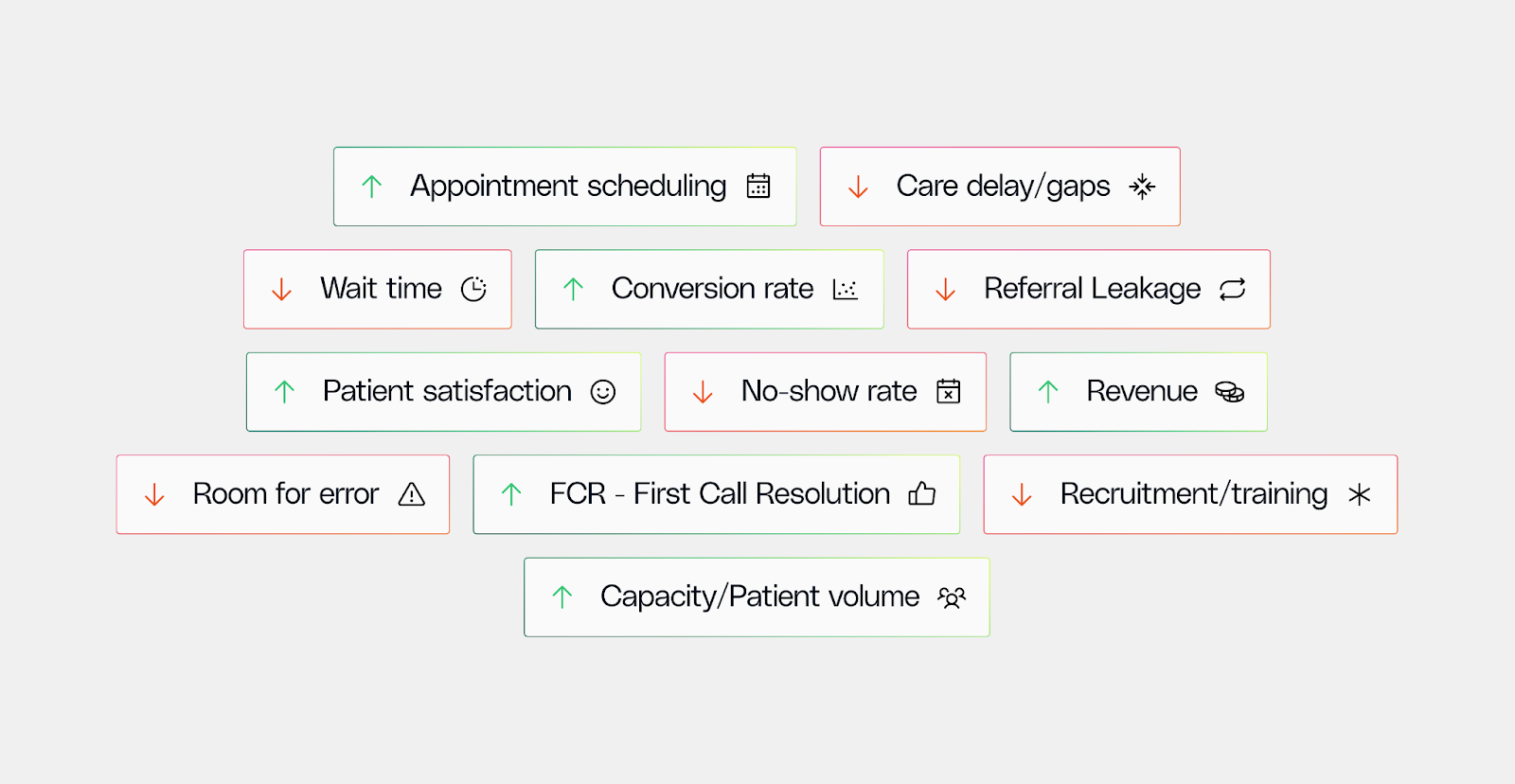
When patients can schedule on their own and get automated reminders, call volumes drop significantly. Staff who used to spend all day on repetitive tasks report much higher job satisfaction. Organizations see meaningful reductions in turnover and recruiting costs, while institutional knowledge stabilizes across the access center team.
This operational shift creates the foundation for addressing a more critical problem: referral leakage. When patients get referrals but never book the appointment, revenue disappears and care gaps widen. AI scheduling fixes this by connecting every step: when the referral comes in, the system reaches out to patients automatically, checks their insurance, and books the appointment, all in one flow. That's why conversion rates jump more than 30%. The usual gaps where patients disappear simply close up.
The financial argument goes beyond just saving money. Better scheduling means providers stay busier. Empty slots fill up, fewer patients no-show, and you get more capacity without hiring more doctors. What it costs to schedule each appointment goes down while the value of each completed visit goes up.
How Organizations Are Using This Now
Healthcare providers use centralized AI scheduling to standardize workflows across dozens of locations and specialties. Progressive organizations are rebuilding their phone-heavy access centers as digital front doors where AI agents handle the first contact and follow-up automatically. Also, specialty care networks use AI to send automated reminders, route patients intelligently, and keep engagement going, which cuts wait times and gets more referrals completed.
Why This Matters Now
AI scheduling isn't a small upgrade. It's what modern healthcare operations need when patient expectations, financial pressure, and clinical complexity are all increasing at once. Organizations still using manual booking are going to struggle competing for patients who've learned from every other industry that access should be immediate and easy.
The question isn't whether to adopt AI scheduling. It's how fast you can implement it. Healthcare leaders should look at where they stand with digital tools, how many referrals they handle, whether their access center is overwhelmed, how patients prefer to engage, and if they're ready to let AI make autonomous decisions. But waiting has its own cost. Every month you stick with manual scheduling means more lost revenue, more burned-out staff, and more ground given up to competitors who've already switched.
How Comet Solves the Scheduling Problem
Comet tackles these challenges with a platform that combines AI agents across all channels, real-time assistance for access center staff, and two-way EMR connections that actually automate workflows. Organizations using Comet see appointment and referral conversions improve by over 30% because AI agents handle routine scheduling, insurance verification, and patient engagement through voice, web, and text.
The Access Center Copilot guides staff through complex interactions in real time and takes care of documentation automatically, which boosts staff performance by roughly 38%. Meanwhile, 70% of routine interactions run completely on autopilot, cutting call volumes so staff can focus on cases that truly need clinical judgment.
Want to see how AI-ready your contact center is? Check out our AI Maturity Calculator.
To see how Comet can optimize your workflows, request a demo.
Also Read: Transforming Legacy Contact Centers Into Autonomous Patient Access Systems

with the Power of Comet


.svg)